NEWS
September 10, 2025
Industry Trends] New Trends Spreading to Construction Sites: 3D Measurement Technology Using Mobile Devices

■ New Trends in the Construction Industry

DX and 3D Measurement In recent years, DX (Digital Transformation) has been advancing rapidly in the construction industry. Among these developments, the adoption of 3D measurement technology has garnered particular attention. By utilizing mobile devices for measurement tasks that traditionally required significant time and manpower, a major transformation is underway. In particular, measurement using easy-to-use devices such as smartphones and tablets has the potential to fundamentally change existing work styles.

■ The Transformation Brought About by Mobile Device Measurement

Until now, there have been no clear standards for as-built inspection in maintenance work and similar projects. However, in cases where no specific regulations exist, it is becoming increasingly possible to use mobile devices for measurement instead of tape-based methods for surface and cross-sectional inspections. Consequently, the use of "measurement using mobile devices" is beginning to be recommended for public works projects in the prefecture.
This initiative is part of an effort to utilize the LiDAR capabilities built into smartphones and tablets for as-built inspection, in line with the Ministry of Land, Infrastructure, Transport and Tourism’s push toward ICT-based construction.

Guidelines for As-Built Inspection Using 3D Measurement Technology (Draft)
https://www.mlit.go.jp/tec/constplan/content/001880735.pdf

■ Our Collaboration with Kotobuki Construction

As a pilot project for this initiative, our company collaborated with Kotobuki Construction Co., Ltd. to introduce " Scanat," a 3D scanning app for iPhone and iPad, into national highway maintenance operations. By creating 3D models of hazardous slopes and other areas directly on-site, we were able to achieve efficient maintenance and repair work.
Key Results
* Significant reduction in measurement time: A slope approximately 70 meters long can be scanned in just 5 minutes
* Labor hours reduced from 36 hours per month to 15 hours per month (approximately 58% reduction)
* Reduced travel through online information sharing: Less travel and fewer return visits required for on-site inspections
* Improved data quality: 3D data enables consistent, experience-independent documentation, eliminating discrepancies in understanding with clients

Collection of Model Project Case Studies Related to Initiatives to Promote Efficient Construction Work Aimed at Realizing Work-Style Reform (Please refer to pages 60–63)

■ How the Technology Works and Its Benefits

LiDAR is a technology that uses laser light to instantly measure the distance to and shape of objects, capturing high-precision point cloud data. Compared to traditional tape-measuring methods, this technology is expected to deliver benefits such as "significantly reduced work time," "reduced staffing requirements," and "improved on-site safety."
In the construction industry, where labor shortages are becoming increasingly severe, these improvements in efficiency and safety are of great significance.

■ Expected Applications

3D measurement using mobile devices is particularly well-suited for cases that do not require coordinate management.
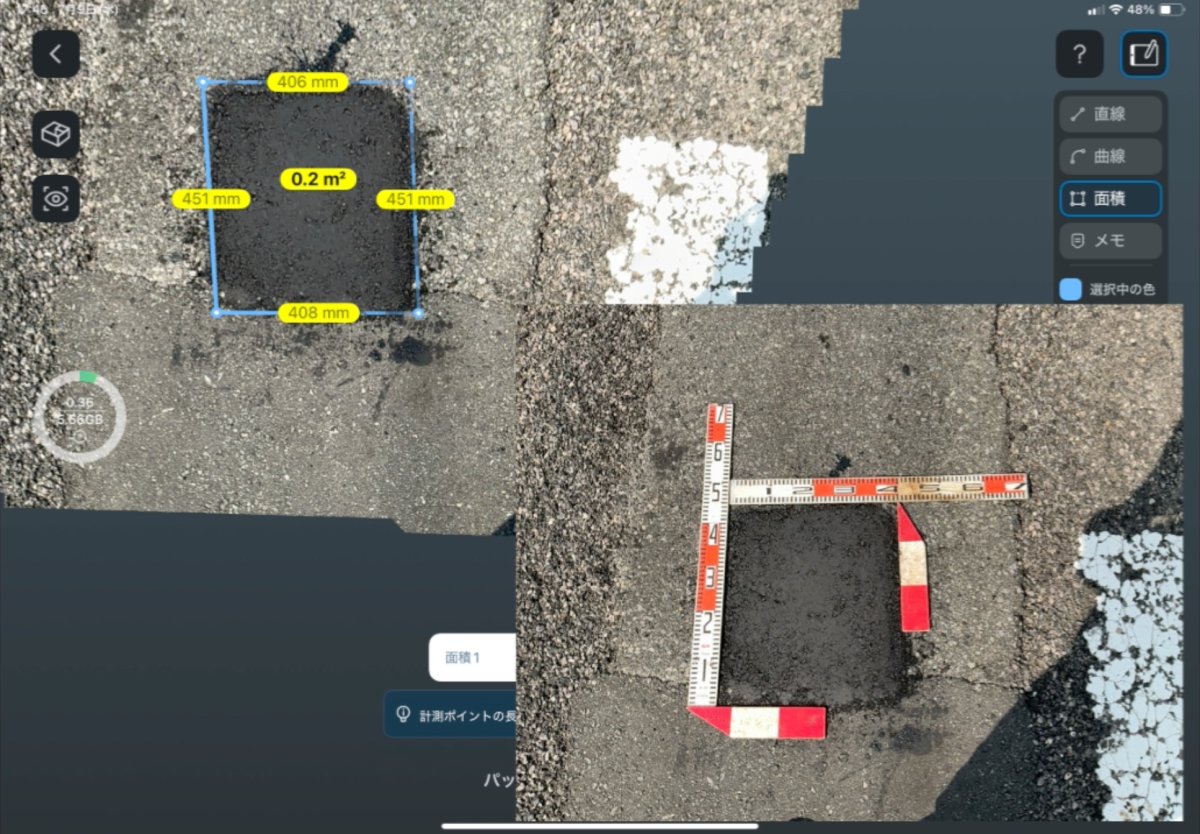
For example: Measuring the area of pavement repairs Measuring the area of reinforcement sheets for bridges and tunnels In such tasks, mobile devices can now be used for measurement instead of traditional tape measures, and their use on actual job sites is becoming increasingly widespread.

■ The Importance of Quality Control

The most important aspect of introducing new technology is precision control. The following standards are required on-site.
・Dimensional accuracy: Within ±10 mm for the distance between two points
・Measurement accuracy: Within ±10 mm for the distance between two points
・Measurement density: Sufficient to clearly define the object’s outline
Therefore, it is recommended to set up a reference gauge with known dimensions for each measurement and verify that the difference from the result is within ±10 mm. This approach ensures both ease of use and reliability.

■ Finally

Our 3D scanning app, " Scanat," has been in use since May of this year for maintenance and renovation projects on national highways and other roads. Since it allows us to submit data directly to clients, we will continue to promote the adoption of 3D measurement technology to streamline operations and improve efficiency in the construction and civil engineering industries, thereby helping to address the challenges posed by aging infrastructure.

We look forward to your continued support.

Reference: Explanatory Video on the Draft Guidelines for Utilizing 3D Measurement Technology in As-Built Inspection [Part 1: General Overview] https://www.youtube.com/watch?v=dGFo22YftqU

Explanatory Video on the Draft Guide to Utilizing As-Built Management Using 3D Measurement Technology [Part 2: Earthwork]
https://www.youtube.com/watch?v=r8h3WMlXhSs

Explanatory Video on the Draft Guide to Utilizing As-Built Management Using 3D Measurement Technology [Part 3: Paving Works]
https://www.youtube.com/watch?v=AJyIuUwi4lE

© 2022 - 2026 nat Inc. All rights reserved.